
How to Split a Lot in Marion County: A Step-by-Step Guide

Looking to split property in Marion County, FL? Learn the zoning rules, survey requirements, and Growth Services approval process — explained by a licensed Ocala surveyor.
Introduction
Splitting land into multiple parcels can unlock new opportunities — whether you’re creating space for family, preparing land for development, or increasing property value. But in Marion County, Florida, lot splits require more than just drawing new lines. They involve zoning checks, surveys, and formal county approval.
This guide explains the lot split process in Marion County step by step, so you know what to expect and how to avoid common pitfalls.

Step 1: Confirm Your Zoning & Lot Requirements
Every parcel in Marion County is assigned a zoning classification (such as R-1 Single-Family, A-1 Agriculture, or R-4 Mixed Residential). These zoning rules determine minimum lot size, width, and setbacks that each new parcel must meet.
Here are a few examples from the Marion County Land Development Code:
R-1 (Single Family Dwelling)
Minimum lot area: 10,000 sq ft (may reduce to 7,700 sq ft if central utilities are available)
Minimum lot width: 85 ft (may reduce to 70 ft with central utilities)
Setbacks: Front 25 ft, Rear 25 ft, Side 8 ft
A-1 (General Agriculture)
Minimum lot area: 10 acres
Minimum lot width: 150 ft
Setbacks: 25 ft on all sides
R-4 (Mixed Residential)
Minimum lot area: 7,500 sq ft (may reduce to 5,000 sq ft with utilities)
Minimum lot width: 75 ft (70 ft with utilities)
Setbacks: Front 25 ft, Rear 25 ft, Side 8 ft
Environmentally Sensitive Overlay (ESOZ)
Waterfront setback: 75 ft from wetland lines or water boundary
Waterfront lot width: 125 ft minimum
👉 Always confirm your parcel’s zoning through Marion County Growth Services before starting the process.
Step 2: Hire a Licensed Surveyor
A survey is required to legally define and record the new lots. Your surveyor will:
Verify existing boundaries and monuments
Draw proposed new lot lines
Create legal descriptions for each lot
Confirm compliance with size, width, and setback requirements
Identify easements and utilities
Without a survey, the county cannot approve or record your lot split.
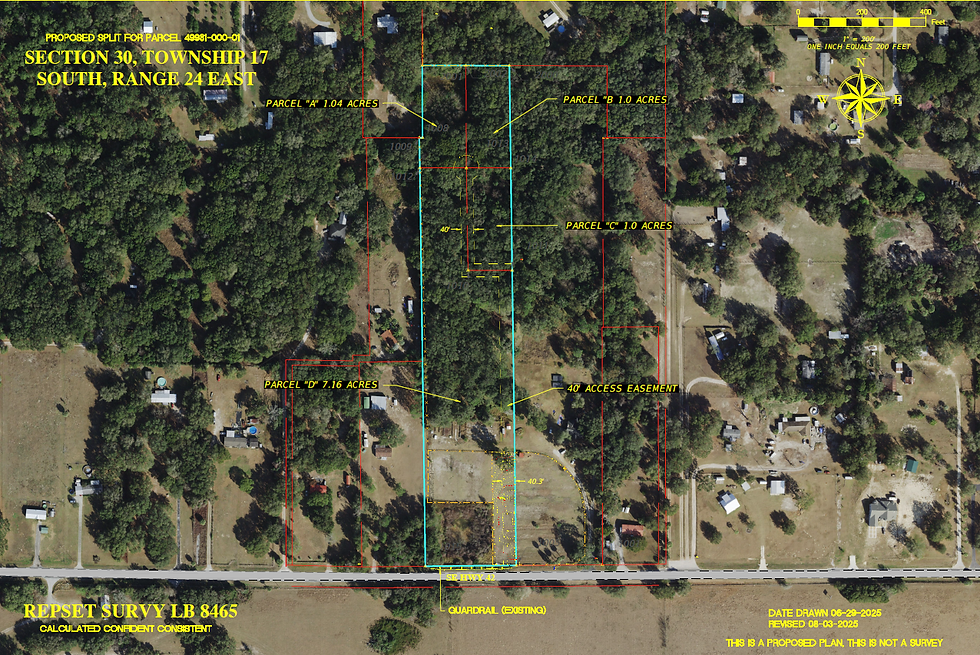
Step 3: Submit Your Application to Growth Services
With the survey complete, prepare an application for Marion County Growth Services. This typically includes:
The proposed survey/plat
Legal descriptions of each new lot
Application form and county filing fees
Supporting documents (such as easement agreements if applicable)
Growth Services staff review applications for compliance with the Land Development Code.
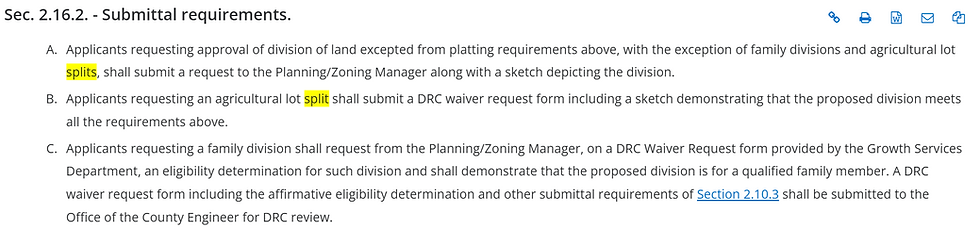
Step 4: Address Access, Easements & Utilities
Each new lot must have legal access and adequate utility easements:
Lots must front on a public road or have a recorded access easement.
Utility easements must meet county standards.
If a lot borders a county road, you may need a driveway or right-of-way permit.
In some cases, additional right-of-way dedication may be required for cul-de-sacs or road improvements.

Step 5: County Review & Approval
Growth Services will review the submittal. For larger or more complex projects, the Development Review Committee (DRC) may also be involved.
Typical timeline: 30–60 days for simple two-lot splits, provided the application is complete and meets code requirements.
Common causes of delay include:
Proposed lots not meeting minimum area or width requirements
Missing easements or access issues
Incorrect setbacks

Step 6: Record the Survey or Plat
Once approved, you or your surveyor records the final plat or survey with the Marion County Clerk of Court. At that point, each lot becomes a separate legal parcel that can be sold, financed, or built on creating instant value.
Best Practices to Avoid Lot Split Pitfalls
Over the years, we have seen certain mistakes repeat themselves when property owners try to split land. Here are 5 insider tips to help you avoid delays and extra costs:
Don’t wait until the last minute to call your surveyor. Waiting until you’re under contract or pressed for time is risky. Involving your surveyor early ensures zoning, frontage, utilities, and legal descriptions are considered from the start.
Understand that a prior survey may not be enough. Even if you have an older survey, a new survey must cover both the parent parcel and the new lot(s). If you switch surveyors, the new one must prepare a fresh package — while professionals generally trust each other they will not blindly sign off on another professional's work.
Be clear in your scope of work. Your surveyor will deliver exactly what you request. If you leave out details — or ask for something unusual that doesn’t comply with county regulations — the county can still reject it, no matter how accurate the measurements are. Clear scope up front avoids wasted effort.
Don’t assume anything. Skipping or overlooking requirements (like easements, frontage widths, or setbacks) might save time in the short term, but it almost always costs more time and money later when corrections are needed.
Make sure the budget is adequate. Between the survey cost, county processing fees, and sometimes even land preparation, the expenses can add up. It’s important to ensure you have enough funds set aside to cover these upfront costs before starting the process.
👉 Planning ahead, budgeting properly, and trusting your surveyor’s expertise are the keys to a smooth, successful lot split. When consideration is taken in the early stages of the process everyone can move on with integrity and confidence.

Conclusion
Lot splits in Marion County create opportunities but require careful attention to zoning rules, survey requirements, and Growth Services approvals. The process can be smooth with proper planning — or stressful if mistakes are made.
👉 If you’re considering a lot split near Central Florida, or anywhere in Marion County, contact Repset Survey. We’ll guide you through each step with accuracy, confidence, and consistency.


Comments